Keenable SELECT: an agent that searches the web in SQL Research reports built by Keenable SELECT, an agent that searches the web in SQL.Every card links the finished report and the full trajectory be
By Coderz Club · 2026-09-01 · Tags: ai, git
Keenable SELECT: an agent that searches the web in SQL
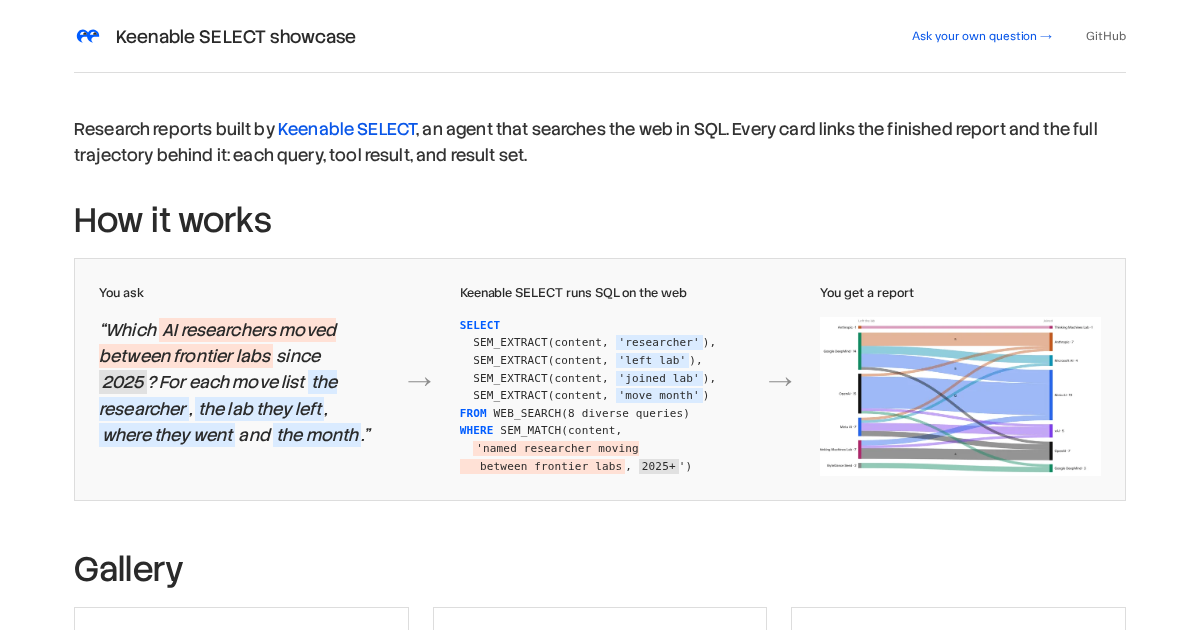
Research reports built by Keenable SELECT, an agent that searches the web in SQL.Every card links the finished report and the full trajectory behind it: each query, tool result, and result set.How it worksYou ask“Which AI researchers moved between frontier labs since 2025? For each move list the researcher, the lab they left, where they went and the month.” Keenable SELECT runs SQL on the webSELECT SEM_EXTRACT(content, 'researcher'), SEM_EXTRACT(content, 'left lab'), SEM_EXTRACT(content, 'joined lab'), SEM_EXTRACT(content, 'move month') FROM WEB_SEARCH(8 diverse queries) WHERE SEM_MATCH(content, 'named researcher moving between frontier labs, 2025+') You get a reportGalleryTwenty Years of YC Startup-Name Morphology2026-09-01 36 messages 18 queriesTrajectory A Living History of Search Engines (1982–2026)2026-08-31 18 messages 10 queriesTrajectory America’s Gigawatt AI Data-Center Buildout2026-08-31 20 messages 10 queriesTrajectory Atlas of Documented Zoo Animal Escapes2026-08-31 20 messages 12 queriesTrajectory Best New Casual Southeast Asian Restaurants in the Bay Area2026-08-31 18 messages 9 queriesTrajectory Bollywood Songs Reported as Copied or Inspired2026-08-31 19 messages 10 queriesTrajectory Death by GPS: Documented Water, Desert & Cliff Incidents2026-08-31 15 messages 9 queriesTrajectory Frontier AI Researcher Moves Since 20252026-08-31 16 messages 9 queriesTrajectory Great Bird Migrations of the World2026-08-31 17 messages 10 queriesTrajectory India’s Famous Mango Origins Map2026-08-31 31 messages 16 queriesTrajectory Major Open & Open-Weight LLM Releases — 2026 Timeline2026-08-31 14 messages 9 queriesTrajectory Marvel Screen Continuities, 2005–2026 — Light Edition2026-08-31 24 messages 12 queriesTrajectory Mechanical Keyboard Releases — 10-Year Timeline2026-08-31 20 messages 10 queriesTrajectory Nearest Zoo Voronoi Atlas — United States2026-08-31 29 messages 16 queriesTrajectory Orbital Launch Atlas, 1957–20262026-08-31 16 messages 9 queriesTrajectory Popular Open-Source AI Agents & Agentic Frameworks2026-08-31 17 messages 9 queriesTrajectory Seattle & Bellevue Coffee Enthusiast Tour2026-08-31 18 messages 9 queriesTrajectory The AI Lab Founder Family Tree2026-08-31 20 messages 10 queriesTrajectory The Great-Chef Kitchen Lineage2026-08-31 16 messages 9 queriesTrajectory U.S. Specialty Coffee Roaster Atlas2026-08-31 13 messages 9 queriesTrajectory What Goes in Common EDC Packs?2026-08-31 16 messages 9 queriesTrajectory Australia’s Big Things — Map and Route2026-08-27Bay Area First-Date Playbook2026-08-27Braintrust (braintrust.dev) — Public-Source Org Chart2026-08-27 The system behind the reports Keenable SELECT is an MCP server with one main tool: select. The tool runs one read-only DuckDB SELECT statement on live web data. The server runs the web and semantic operators outside DuckDB, puts their output back into the row set, and then runs the final SQL in DuckDB. A traditional web search gives an agent ten links. The agent must then read each page and build the answer from expensive tokens. SELECT moves this work into the query. One call can search more than 1,000 pages, filter them with an exact WHERE clause at no LLM cost, extract fields with one small LLM call per row, and group the rows. MCP tools select takes DuckDB SELECT queries and returns the rows. The server saves every query result as a result set with an id, and a later query can read from that id. generate_html_report takes a brief and result set ids. A report model on the server writes an HTML report from the rows and returns a shareable link. Semantic operators The operators live inside normal SQL. The server finds them in the parsed statement, runs them, and replaces them with plain columns. Exact SQL filters run first, so only the surviving rows go to the LLM operators. OperatorWhat it does WEB_SEARCH('q1', 'q2', ...)Searches all queries at the same time, merges ranked results, and removes repeated URLs. WEB_FETCH('https://a.com', ...)Gets the given URLs as Markdown, one row per page. SEM_EXTRACT(column, 'field description')One LLM call per row. It returns one field, or null when the text does not give the value. SEM_EXTRACT_ALL(column, 'what one value is')Like SEM_EXTRACT, but returns all matching values in a list. SEM_MATCH(column, 'predicate')An LLM test per row. Use it as a meaning-based WHERE filter. SEM_SCORE(column, 'query')A low-cost embedding score per row. Use ORDER BY ... DESC LIMIT k. SEM_NORM(column)Gives the same key to values with the same meaning. Use it in GROUP BY. WEB_SEARCH and WEB_FETCH can also run per row. Their arguments can use row columns, for example WEB_SEARCH(name || ' founding year'). Main agent Every report in this gallery comes from two agents: a research agent that uses the MCP server to gather the data, and a report agent that runs inside generate_html_report on the server and writes the page. The research agent is a plain tool loop: an LLM wi
Research reports built by Keenable SELECT, an agent that searches the web in SQL.Every card links the finished report and the full trajectory behind it: each query, tool result, and result set.How it worksYou ask“Which AI researchers moved between frontier labs since 2025? For each move list the researcher, the lab they left, where they went and the month.” Keenable SELECT runs SQL on the webSELECT SEM_EXTRACT(content, 'researcher'), SEM_EXTRACT(content, 'left lab'), SEM_EXTRACT(content, 'joined lab'), SEM_EXTRACT(content, 'move month') FROM WEB_SEARCH(8 diverse queries) WHERE SEM_MATCH(content, 'named researcher moving between frontier labs, 2025+') You get a reportGalleryTwenty Years of YC Startup-Name Morphology2026-09-01 36 messages 18 queriesTrajectory A Living History of Search Engines (1982–2026)2026-08-31 18 messages 10 queriesTrajectory America’s Gigawatt AI Data-Center Buildout2026-08-31 20 messages 10 queriesTrajectory Atlas of Documented Zoo Animal Escapes2026-08-31 20 messages 12 queriesTrajectory Best New Casual Southeast Asian Restaurants in the Bay Area2026-08-31 18 messages 9 queriesTrajectory Bollywood Songs Reported as Copied or Inspired2026-08-31 19 messages 10 queriesTrajectory Death by GPS: Documented Water, Desert & Cliff Incidents2026-08-31 15 messages 9 queriesTrajectory Frontier AI Researcher Moves Since 20252026-08-31 16 messages 9 queriesTrajectory Great Bird Migrations of the World2026-08-31 17 messages 10 queriesTrajectory India’s Famous Mango Origins Map2026-08-31 31 messages 16 queriesTrajectory Major Open & Open-Weight LLM Releases — 2026 Timeline2026-08-31 14 messages 9 queriesTrajectory Marvel Screen Continuities, 2005–2026 — Light Edition2026-08-31 24 messages 12 queriesTrajectory Mechanical Keyboard Releases — 10-Year Timeline2026-08-31 20 messages 10 queriesTrajectory Nearest Zoo Voronoi Atlas — United States2026-08-31 29 messages 16 queriesTrajectory Orbital Launch Atlas, 1957–20262026-08-31 16 messages 9 queriesTrajectory Popular Open-Source AI Agents & Agentic Frameworks2026-08-31 17 messages 9 queriesTrajectory Seattle & Bellevue Coffee Enthusiast Tour2026-08-31 18 messages 9 queriesTrajectory The AI Lab Founder Family Tree2026-08-31 20 messages 10 queriesTrajectory The Great-Chef Kitchen Lineage2026-08-31 16 messages 9 queriesTrajectory U.S. Specialty Coffee Roaster Atlas2026-08-31 13 messages 9 queriesTrajectory What Goes in Common EDC Packs?2026-08-31 16 messages 9 queriesTrajectory Australia’s Big Things — Map and Route2026-08-27Bay Area First-Date Playbook2026-08-27Braintrust (braintrust.dev) — Public-Source Org Chart2026-08-27 The system behind the reports Keenable SELECT is an MCP server with one main tool: select. The tool runs one read-only DuckDB SELECT statement on live web data. The server runs the web and semantic operators outside DuckDB, puts their output back into the row set, and then runs the final SQL in DuckDB. A traditional web search gives an agent ten links. The agent must then read each page and build the answer from expensive tokens. SELECT moves this work into the query. One call can search more than 1,000 pages, filter them with an exact WHERE clause at no LLM cost, extract fields with one small LLM call per row, and group the rows. MCP tools select takes DuckDB SELECT queries and returns the rows. The server saves every query result as a result set with an id, and a later query can read from that id. generate_html_report takes a brief and result set ids. A report model on the server writes an HTML report from the rows and returns a shareable link. Semantic operators The operators live inside normal SQL. The server finds them in the parsed statement, runs them, and replaces them with plain columns. Exact SQL filters run first, so only the surviving rows go to the LLM operators. OperatorWhat it does WEB_SEARCH('q1', 'q2', ...)Searches all queries at the same time, merges ranked results, and removes repeated URLs. WEB_FETCH('https://a.com', ...)Gets the given URLs as Markdown, one row per page. SEM_EXTRACT(column, 'field description')One LLM call per row. It returns one field, or null when the text does not give the value. SEM_EXTRACT_ALL(column, 'what one value is')Like SEM_EXTRACT, but returns all matching values in a list. SEM_MATCH(column, 'predicate')An LLM test per row. Use it as a meaning-based WHERE filter. SEM_SCORE(column, 'query')A low-cost embedding score per row. Use ORDER BY ... DESC LIMIT k. SEM_NORM(column)Gives the same key to values with the same meaning. Use it in GROUP BY. WEB_SEARCH and WEB_FETCH can also run per row. Their arguments can use row columns, for example WEB_SEARCH(name || ' founding year'). Main agent Every report in this gallery comes from two agents: a research agent that uses the MCP server to gather the data, and a report agent that runs inside generate_html_report on the server and writes the page. The research agent is a plain tool loop: an LLM wi